

The Earth continues on its orbit around the Sun and that dips lower in our northern skies. Human intervention will accelerate the path to darkness by putting the clocks back on the 25th when 6pm will become 5pm. No doubt there will be complaints from the Scots as the further north you are the earlier darkness falls.
Take advantage of the early darkness to do some planet spotting. Saturn is at opposition on the 4th which means it is as close to us as it will come (1262million km) and be on the end of a line drawn from the Sun, through Earth. In other words, it is exactly opposite the Sun in the sky. Put your back to the sunset at 7pm and Saturn will be just above the eastern horizon. Trouble is, we enjoy a western horizon on this part of The Wash. Cromer cliffs have a good eastern one
However, from 9pm, the Earth’s rotation will raise Saturn in the sky above roof tops and it will be in the ESE and, by 11pm, in the SE. As the month wears on, so Saturn will appear higher in the sky earlier. By the end it should be visible from 6pm. Get out binoculars, birding scopes and anything better. Saturn will have a magnitude of +0.3 so clearly visible and its rings have begun to open up from their edge on presentation last year. They will be tilted about 8o towards us. Their icy particles will be reflecting light straight back to Earth and the rings will appear brighter than when Saturn is not in opposition.
Saturn has 293 confirmed moons, more than any other planet (this was a question on a recent University Challenge). They range in size from Titan, bigger than the planet Mercury, to many that are lumps of material about the size of a McDonald’s site. If you can see the rings, you can see the spark of light which is Titan that was first discovered in 1655 by Huygens. Others of the larger, brighter, moons followed between 1671 and 1898. Good eyes, through a telescope, might see one or two of these but a photographic image is really needed.
Though elliptical orbits make Earth to planet distances change depending upon where planets are in their orbits, Saturn is typically twice as far from Earth as Jupiter. Consequently, Saturn’s satellites don’t stand out like Jupiter’s 4 Galilean moons, discovered in 1610.
Saturn is close to the Gibbous Moon on the 23rd, look to the left about a fist, at arm’s length, away. On the 24th it is a similar distance below the Moon.
The two ice giants beyond Saturn are in the sky. Uranus is closest and just on the edge of visibility in a very dark sky if you have young, very good, eyes. So that means decent binoculars for many, a telescope for some. I would leave it to the middle of the month to observe it from about 10.45pm. It will be above the bright star Aldebaran, separated from it by the distance a fist makes at arm’s length.
Uranus was first recognised as a planet in 1783 when William Herchel finally acknowledged that the comet he had discovered in 1781 was, in fact, a planet. Other astronomers had implied that it was so in the intervening two years. Uranus is twice as far away as Saturn so it’s not surprising that it took several observations by several people to determine its orbit. The darker skies of hundreds, thousands of years ago would have made Uranus an easier object to see with unaided eyes and it was seen, many times. Hipparchus catalogued it in 128 BC but as a star. This error carried on right up to Herchel who had the benefit of a telescope.
Uranus has 29 moons, a very dark ring system and is tilted over by almost 90o so one pole always faces the Sun and the other, obviously never faces the Sun. A theory that a large planet collided with the proto-Uranus long ago and knocked it over was used in opening credits for Third Rock from the Sun (a decades old tv comedy), and illustrated it well.
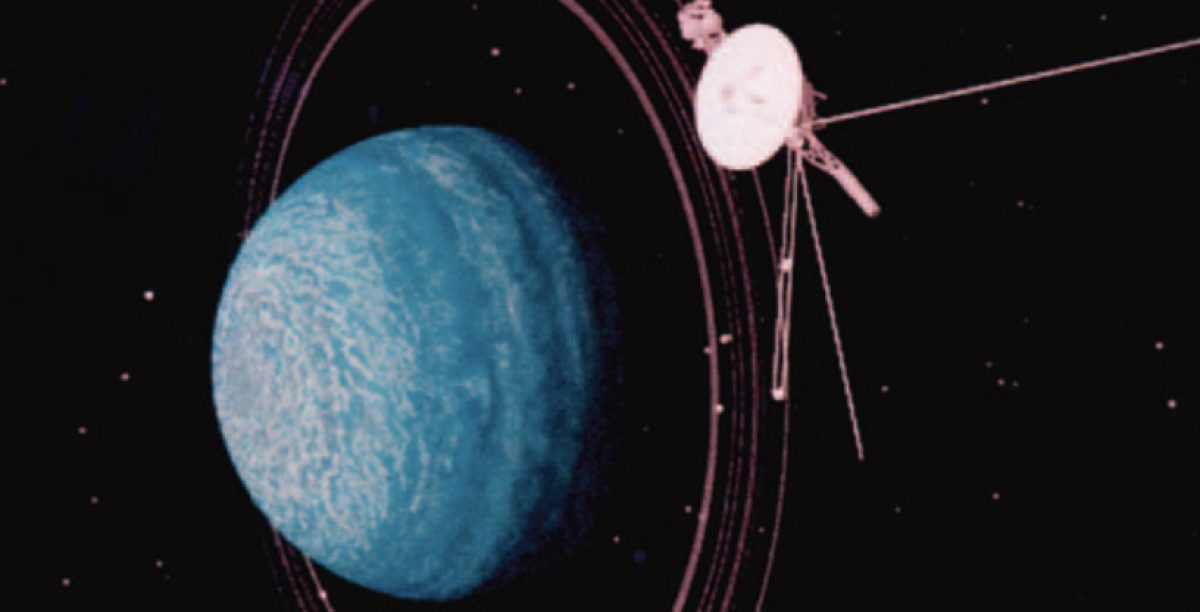
The only spacecraft that has flew by Uranus was Voyager 2 in 1986. The craft sent back information about its atmosphere and magnetic fields, found more moons and rings and carried on past Neptune and beyond. It is still in contact with Earth but energy supplies will end by 2030.
Uranus will appear as a fuzzy bluey green dot in your eye, albeit through binoculars or telescope and is worth the effort; it is around 1.76 billion miles away.
Neptune is much harder to observe as it is around another billion miles beyond Uranus. Its apparent magnitude is +7.7 which is 1/7th the brightness of dim Uranus at +5.6. An astronomical telescope is needed to see it but you can imagine the greenish coloured world when you look at Saturn. It will be in the same area of sky, to the west, right, of the ringed planet about the width of a fist at arm’s length away.
So far you have been able to see planets at reasonable times in the evening. Early hours of the morning are now necessary to see mighty Jupiter shining brightly with a magnitude of minus 1.9. It rises in the NE at 2am but is high enough to observe at 4am when it will be due east. (Times are for the middle of the month, observation improves as the month progresses). Use large objective lens binoculars or a bird ‘scope to spot the Galilean Moons.
Whilst spotting Jupiter you may as well seek out Mars. The red planet rises in the NE by 1am and is always above and to the right of Jupiter. In the middle of the month, they are about two fists away. They close to about one fist by the end of the month.
Both planets should till be visible in the lightening sky around 6am, not so bad but don’t leave it later. They will be SSE, well to the right of the soon rising Sun.
On the 5th, at 6am, the fat Crescent Moon will pass just over Mars; on the 6th it will pass over Jupiter. In the early hours of the 11th, the red planet will be in front of a pretty star cluster, Praesepe or The Beehive.
The second pass of the Earth through the debris from Halley’s Comet occurs on the night of the 21/22nd. It will be the peak of the Orionids meteor shower best looked for in the early hours but take a look from 9pm towards the NE. Between midnight and 1am the radiant, point from which meteors appear, has shifted to the east and is to the left of Orion. However, you see meteors when they hit the atmosphere and this can happen almost anywhere across the sky, notably behind you. The recommended technique is to lie on your back looking straight up but I usually look NE whilst darting my eyes to either side. Remember to get your eyes dark sensitive and not use white light torches.
You won’t see Mercury as it is hidden in the glare of the Sun but spacecraft Bepi Columbo arrived close to it on the 3rd September after an 8-year journey. Falling towards the Sun makes a spacecraft speed up so BepiColumbo had to spend 8 years braking. To lose speed it used the Gravity of Earth, Venus, and Mercury in 9 planetary flybys. Spacecraft flying the other way, towards distant Jupiter, for example, use planetary flybys as sling shote to accelerate them.
BepiColumbo will make its final orbit insertion in November and start mapping the planet. More then.
Enjoy the dark by catching some planets and a meteor or two. And don’t forget mighty Orion now rising into the sky before dominating it in the winter.
Terry Parish

