

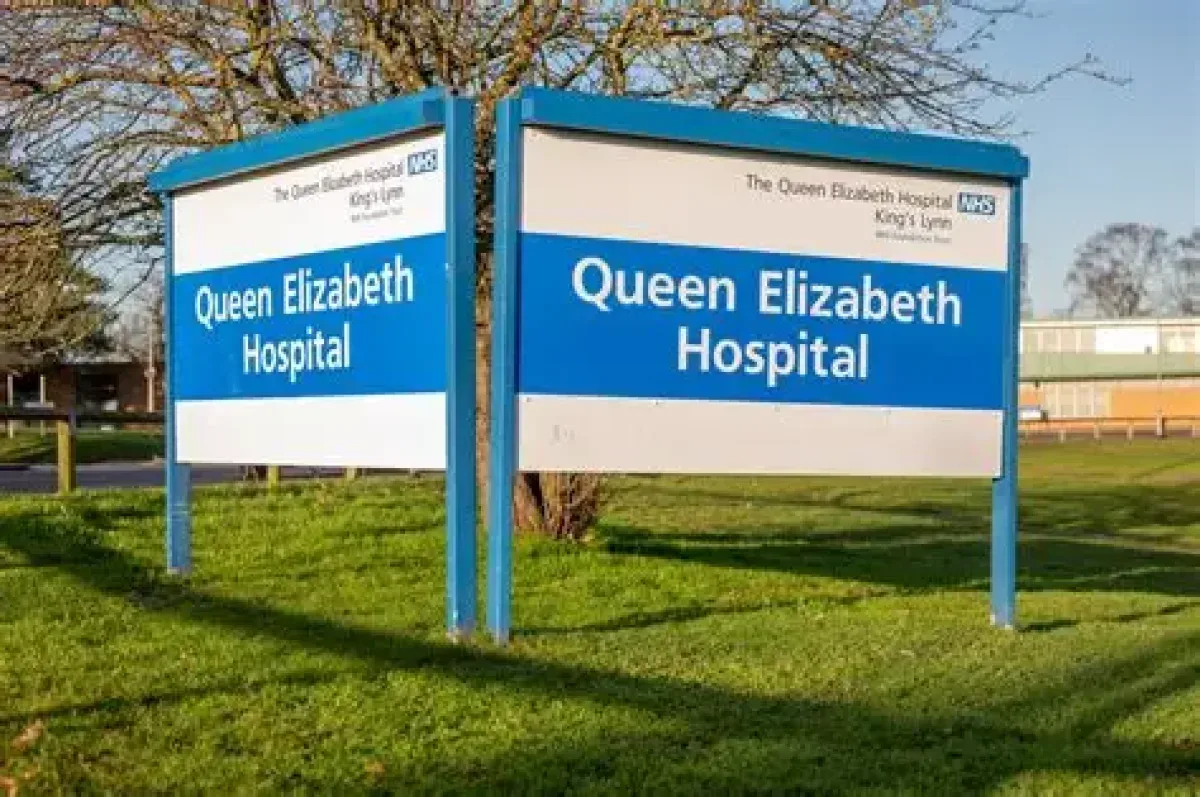
The update came on Thursday evening as more than 170 people joined the QEH's Annual Members' Meeting, either in person in King's Lynn or online.
It was an opportunity to hear about the work taking place at the hospital, but two subjects understandably attracted particular attention: when West Norfolk will finally get its new QEH and what services will be provided there in the future.
Professor Lesley Dwyer, group chief executive of the Norfolk and Waveney University Hospitals Group, was questioned about the new hospital by Councillor Rob Colwell.
"The current date is in 2033. It was 2032," she told the meeting.
Professor Dwyer said the change was not something controlled locally and acknowledged there had been delays within the wider New Hospital Programme.
But she was also keen to stress that work in King's Lynn has not stopped.
"One of the things that we are so cautious and careful of is that we need to do this work. That's a given," she said.
"It is absolutely required of us, but we're also keeping a really close eye on any timelines and decisions around the new programme because it's had a couple of delays, but you can see what's happening at the Queen Elizabeth, we are still moving on."
She said the new hospitals, which also include a replacement for the James Paget Hospital in Great Yarmouth, are on track to be delivered by 2033.
"We will not do anything to slow that down," she added. "We do need to replace those hospitals."
Professor Dwyer said the new facilities would be fully functioning, with staff "well in there", by 2035.
Work is already happening
For anyone passing the QEH regularly, there are already visible signs of preparation for the new hospital.
Enabling work is under way and a new multi-storey car park forms an important part of the project, freeing up land required for the main hospital development.
The QEH is one of the hospitals included in the Government's New Hospital Programme because of the extensive use of reinforced autoclaved aerated concrete, commonly known as RAAC, within the existing building.
So while 2033 will come as a disappointment to those who have followed the long campaign for a replacement hospital, the project itself continues to move forward.
Questions over emergency care
The other major issue raised on Thursday evening was the future of emergency services at the QEH.
Earlier reports about options being considered as part of a long-term clinical strategy for Norfolk and Waveney prompted considerable concern locally.
Councillor Colwell subsequently launched a petition opposing the loss of key services from the QEH, which he said has now attracted more than 9,000 signatures.
He used Thursday's meeting to put those concerns directly to Professor Dwyer.
"I'm pleased that it has come out because what it has enabled to happen is that, while we understand that this is at a very early stage, it's allowed the community's voice to be heard at a very early stage," he said.
"My message is that I hope that the chair of the group hears very loudly that we appreciate that you have to do a job and you have to look through all of the data and information and analyse things, but we as a community cannot understand a position whereby West Norfolk would be without a full consultant-led A&E."
Professor Dwyer reiterated that emergency care would continue to be available around the clock.
"We absolutely accept that all of our hospitals will need to have 24-hour emergency care, but you also heard that we have to look at what is that type of care," she said.
That distinction is important.
The Norfolk and Waveney University Hospitals Group is developing a long-term clinical strategy looking at how services could be provided across the QEH, Norfolk and Norwich University Hospital and James Paget University Hospital.
Different models of care are being explored, but the Group has repeatedly stressed that no decisions have been made.
Professor Dwyer told Thursday's meeting that she could not predict what those models would look like years into the future.
"I can't predict what the models of care will be well into the future, but all we can do is make sure that we look to the evidence, we look to the population's need, and we take advice from our clinicians.
"It would be false of me to stand here when we've asked people to do the work to say we've already made these decisions."
She made clear that the QEH would continue to provide 24-hour emergency care, although she did not give a commitment that the service would necessarily continue in exactly its current form.
"People across West Norfolk have waited long enough"
Following the meeting, Councillor Colwell said the latest timetable for the hospital was disappointing.
"This is deeply disappointing news for West Norfolk," he said.
"Our community fought incredibly hard for the QEH rebuild and was already reeling from the previous delay from 2030.
"I asked the question directly in a packed room because people deserve clarity.
"I was told the trust is now working towards 2033, another year later than the 2032 timetable we had been given.
"People across West Norfolk have waited long enough.
"Staff and patients deserve a modern hospital, and our community deserves a clear timetable that is then stuck to.
"I will be pressing for answers about why the date has slipped again and what is being done to prevent any further delays.
"Our community petition to save vital life-saving services continues and has now passed 9,000 signatures."
Plenty still to be decided
Thursday evening's meeting provided some answers, but inevitably left questions too.
The commitment to build a replacement QEH remains, and work connected with delivering it is already taking place in King's Lynn.
The hospital group has also been clear that no decisions have been made about changing the configuration of services at the QEH.
What has changed is the timetable being discussed for the new building, with Professor Dwyer now pointing towards 2033 rather than 2032.
And for a community which has campaigned for years for a modern hospital, both the date on which that building opens and the services available when people walk through its doors will continue to matter enormously.

